Tuesday, 13 July 2021

DRIVING BACK THE INVADERS

by Ernie Trory

Under the Moscow agreement of December 1945, it had been agreed by Britain, the USA and the USSR that after its liberation from Japanese rule, Korea would become a unified, independent, democratic state. In violation of this agreement, the government of the USA took advantage of the provisional military occupation by the victorious powers to set up a regime in south Korea subservient to Washington. The USA poured money into south Korea together with weapons and military advisers.
    In spite of the economic crisis that was beginning to make itself felt in the USA, 1,225 million dollars was invested in south Korea. The New Corea Company, whose assets were formerly owned by a Japanese trust, was floated and its shares marketed by the National City Bank. Among its assets, the New Corea Company claimed half the mines, railways,banks and arable land in north Korea!
    The Oriental Consolidated Mining Company, also formerly Japanese but now in American hands, claimed ownership of the Unsan gold mines, also in the Democratic People's Republic of Korea and said to be the richest in all Asia.
    The President of south Korea was Syngman Rhee, a man who had spent 30 years in the United States and who had been brought back to south Korea to head the puppet government set up by the Americans. Syngman Rhee abolished the free press and liquidated the political opposition with brutal violence. In an interview with United Press, on 7th October 1949,
Syngman Rhee boasted that the South Korean army could take the north Korean capital of Pyongyang within three days. On the 1st November, the New York Herald Tribune reported that Syn Sung Mo, the south Korean War Minister had declared that his army was ready and waiting to push into north Korea. There had already been a considerable number of border
incidents.
     At a conference with his divisional commanders in Seoul during October 1949 General Roberts, Chief of the American Military Mission in Korea, said: "Certainly there have been many attacks on the territory north of the 38th parallel on my orders, and there will be many others in the days to come ... From now on, the invasion by the land forces of the
territory north of the 38th parallel is to be carried out only on the basis of orders of the American military mission."
    This is quoted in Thus Wars Are Made by Albert Norden, who also tells us that three months later, in January 1950, General Roberts announced: "The campaign against the north has been decided upon, and the date for carrying it through is not very far off." Documents of the Syngman Rhee government, captured during the subsequent occupation of Seoul by the Korean Peoples Army and published by the north Korean government, confirmed the systematic preparation of the invasion of north Korea from the south.
    On the 14th March 1950 a correspondent of the New York Times named Sullivan reported from Seoul that 13 deputies of the National Assembly of douth Korea had been sentenced to imprisonment for periods ranging from one and a half to ten years for violations of the Security Act. Each was found guilty on five charges, of which the fourth was "opposing the invasion of North Korea by the South Korean forces."
    In the south Korean elections of the 30th May 1950 Syngman Rhee suffered a crushing defeat and his support in the New National Assembly was reduced to less than a quarter of the seats. The overthrow of his hated regime seemed certain and its impending collapse was openly predicted. The general opinion was that only a victorious war could raise his prestige enough to save him.
    Early in June 1950 Secretary of State Acheson's adviser, John Foster Dulles, who was a member of the board of directors of the National City Bank that had marketed the shares of the New Corea Company, appeared in south Korea. His photograph, taken on the border between south Korea and north Korea in the company of high American and south Korean officers by Associated Press on the 19th June, was flashed round the world. On that
same day, in an address to the South Korean National Assembly, Dulles prophesied that "the Communists will lose their rule over North Korea."
    On the 20th June the Swiss paper, Zuricher Zeitung, said: "There is no lack of people in South Korea who see the solution of the problems weighing heavily upon the country in a military attack on the north. The Americans have outfitted 150,000 men with American
weapons, have put them under the command of American instructors, and have long been preparing for war."
    While Dulles was in south Korea, the US Secretary for Defence, Lyndon B Johnson, and the Chief of the General Staff, Omar Nelson Bradley, were in conference in Tokyo at the headquarters of General MacArthur. On the 21st June, Dulles arrived in Tokyo from South Korea and after long talks with MacArthur told the press that he "prophesied positive action by the USA."
    On the 25th June 1950, the day of the invasion of north Korea, John Gunther, the American writer, found himself in MacArthur's private railway car on a pleasure trip in the vicinity of Tokyo. MacArthur's chief political adviser was to have accompanied him but he had to cancel his plans as MacArthur needed him. He was replaced by two other high
officers who accompanied Gunther. According to Gunther, one of them was "unexpectedly called to the telephone just before dinner." When he returned, he told Gunther: "A tremendous story is just coming out. The south Koreans have attacked North Korea."
    This was confirmed by General MacArthur himself on the 30th July,When he told press correspondents assembled at his headquarters in Tokyo: "When the war began on the 25th June, the North Korean army had not carried out its mobilisation plan. Only six divisions were ready, although the North Korean plans call for 13 to 15 divisions in case of
war." It had been reported by field observers of the United Nations on the 24th June, a few hours before hostilities had begun, that "no reports have been received of any unusual activity by North Korean forces that would indicate any impending change in the general situation along the frontier." But officers of the South Korean forces captured after the outbreak of war insisted that on that particular day, their regular Saturday leave had been cancelled and that on the following day they had been ordered to begin "the full phase of the attack north of the 38th parallel."
    Kim I Sek and some other south Korean leaders were captured at the very beginning of the war. They gave valuable information. A number of documents were also captured which showed quite clearly that the south Koreans, backed by the Americans, were the aggressors. According to Kim I Sek, the final instructions given to Syngman Rhee by Dulles went as
follows: "Start the aggression against the north, accompanied by a counter-propaganda on the grounds that the North has invaded the South first. If you can but hold out for two weeks, everything will go smoothly, for during this period the United States, by accusing North
Korea of attacking South Korea, will compel the United Nations to take action, in whose name land, naval and air forces would be mobilised."
    The invasion started in the early hours of the 25th June. According to a captured front-line officer, Lieutenant Han Su Whan, formerly of the 17th Regiment of the south Korean army: "Though the 24th was a Saturday, officers of the regiment were not allowed to go out; they were ordered to be on the alert. We all stayed up that night in tense mood, and by daybreak of the 25th a secret order reached us from Headquarters to launch an attack on the region north of the 38th parallel line. All the units which had launched the sudden attack from the Ongjin area broke through the 38th parallel line, and their advance covered from on to two kilometres ... Soon after we launched our attack, we were confronted by a fierce counter-offensive of the Constabularies of the People's Republic ... We, who had been so proud of being equipped with American arms of ultra-modern type, collapsed immediately everywhere before the Constabularies of the People's Republic; even the 53 rocket guns we had were of no use.
    In his book New Light on Korea D.N. Pritt wrote: "Within eight hours of the first news of the hostilities reaching Washington, the Security Council was summoned ... Its members were called from their sleep at 3 a.m and twelve hours later, in the absence of the Soviet representative, and of any representative of China (the nominee of the defeated bandit Chiang Kaishek still sitting in China's seat), they had passed what appeared to be a resolution of the Security Council."
    According to the Charter of the United Nations, all five permanent members of the Security Council had to concur before any resolution could be said to be valid. The representative of the USSR, objecting in principle to China's being represented by the nominee of a government that had ceased to exist, did not attend. The resolution was, therefore, totally void. It nevertheless condemned "the invasion of the Republic of Korea by armed forces from North Korea" and recommended its members to give military aid to South Korea.
    In reaching its decision the Security Council neither asked the DPR Korea to give its version of the outbreak of hostilities nor took into consideration its claim that the aouth Koreans were the aggressors. On the 2nd July, the Observer boasted: "The Security Council, overnight, was transformed into the executive authority of non-Communist world opinion," adding that it had "suddenly begun to work as it was intended to work." On the same day, the West Berlin Telegraf told its readers that South Korea, which it described as "the last corner of democratic freedom on the Chinese mainland," had been subjected to "the cowardly attack of Communism."
    In a statement made on behalf of the Soviet government on the 4th July, Gromyko accused the Security Council of "acting not as a body invested with the main responsibility for the maintenance of peace, but as an instrument employed by the US ruling circles with the object of unleashing war." Unlike the USA, whose President was already threatening to occupy Formosa and the nominally independent Philippines, as well as sending a military mission to Indo-China and calling for a crusade against every socialist country in the world, the USSR remained calm.
    Within three days of the outbreak of war, the People's Army of the DPR Korea had driven back the south Korean invaders and liberated Seoul. But the Americans had anticipated this possibility and had already landed three infantry divisions, one armoured division and one marine division in south Korea. This was, of course, in violation of all international agreements. On the 26th and 27th June, the US forces bombarded north Korean cities and villages, shot up harbours and landed transports under the protection of the Pacific Fleet and the Seventh Fleet, which pushed into north Korean territorial waters. On the 5th July, West German radio announced that the Americans had "rounded up the South Korean troops, who were retreating in panic, and brought them back into position." It was to be three years before the USA, with official losses of 25,000 dead and 100,000 wounded, were forced to agree to an armistice.
    The people of the USA and of Korea paid for the war with their lives but the industrial-military complex of the USA reaped its profits in dollars. The industrialists of West Germany also raked in the dollars. In 1950 West Germany increased its exports to the USA from 46.5 million dollars to 102.4 million dollars; and in 1955 its exports to the USA reached 356.3 million dollars. This was the basis of the post-war recovery of the Federal Republic of Germany, then being described as an economic miracle.
    The Chancellor of West Germany, Konrad Adenauer, used the Korean conflict to create a German army in secret, without the knowledge even of his own government, but in conspiracy with the rulers of the USA. Like Hitler before him, he later justified this by repeatedly declaring that the purpose of the new German army was for the waging of a war against the east.

a revised extract from Churchill and the Bomb

Wednesday, 30 June 2021

Honouring Kim Jong Il

by New Worker correspondent


Korean solidarity activists met online last Saturday to mark the 57th anniversary of the start of work of dear leader Kim Jong Il at the Central Committee of the Workers Party of Korea (WPK) in 1964, and also the 20th anniversary of the Korean Friendship Association (KFA) UK.
    KFA members from all over Britain took part in the meeting, including the organisers of branches in Staffordshire, Scotland and the West of England. Observers from the Cambodian and Canadian KFAs also joined in the online conference.
    Congratulatory messages were received from KFA President Alejandro Cao De Benos, the Democratic People’s Republic of Korea (DPRK) Embassy in London, the DPRK Committee for Cultural Relations, the DPRK Committee for Friendship with Britain, the Pyongyang Mission of the Anti-Imperialist National Democratic Front of south Korea, and KFA Singapore.
    The message from the Korean Committee for Friendship with Britain said: “This year is a very significant year which marks 20 years of history of KFA UK. For the past two decades, KFA UK has always been in the frontline of friendship and solidarity activities with DPRK and made great achievements. No words could match your efforts, we would just like to emphasise that we are grateful and appreciate your contributions highly.”
    KFA President Alejandro Cao De Benos stressed that: “KFA-UK is one of our most active branches in the world, from conferences to interviews, from pickets to the publication of People’s Korea Today, your pace and spirit is inspirational and unmatchable. Being a model, many newcomers will be assisted by KFA-UK for training and advice.”
    The DPRK London embassy said: “Our embassy highly appreciates that KFA of Britain has been struggling to strengthen the association and defend the rights and interest of working people since its foundation 20 years ago.”
    Dermot Hudson, the KFA-UK Chair, spoke about the 20th anniversary of the foundation of KFA-UK, stressing its role in taking “the struggle to defend People’s Korea to the streets and picketing the US embassy, south Korean puppet embassy, the BBC, Channel Four and the Ministry of Defence”, adding: “Of course it has never been easy, far from it. The establishment and the elite do not want to see the pro-active and energetic defence of the DPRK.”
    Speaking about the 57th anniversary of the start of work of the great leader comrade Kim Jong Il at the Central Committee of the WPK, Hudson said that Kim Jong Il’s starting work at the WPK Central Committee was an event of immense importance. His leadership enabled the WPK to hold up the Juche idea authored by President Kim Il Sung, the great leader of the Korean people and the founder of the WPK, as its immutable guiding ideology and guiding ideal, the Juche idea.
    It was reported that KFA-UK has grown on Facebook despite obstructions from Facebook that saw the main site and others banned for certain periods. Despite the COVID‑19 pandemic KFA-UK has been very active, holding many online events.
    A new KFA-UK Constitution was endorsed without dissension. The meeting included a short presentation by Dermot Hudson on the subject of the Korean war – the imperialist invasion, led by the USA, which was started by the south Korean puppets on the orders of their American masters.
     After an online toast to the 20th anniversary of KFA-UK was drunk, a message to DPRK Supreme Leader Kim Jong Un was adopted.

Saturday, 19 June 2021

Solidarity with the DPRK!


International Webinar Discusses Present Situation and Developments in DPRK


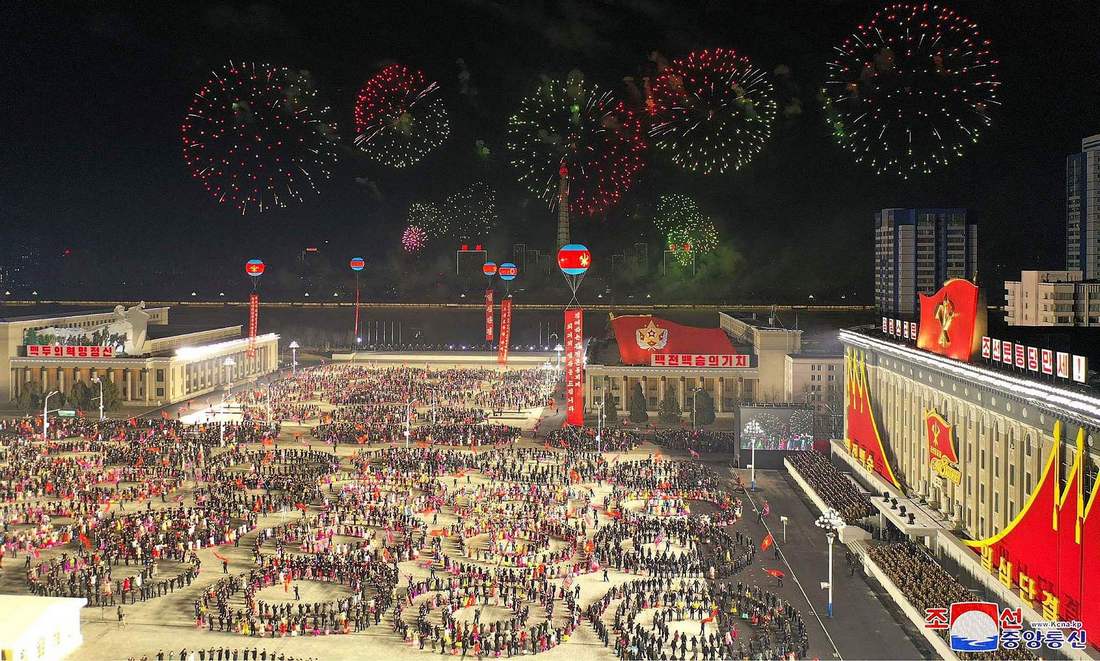
Celebration in Pyongyang of the successful conclusion of the 8th Congress of the Workers' Party of Korea in January 2021. 
  Thirty-eight  international Korean solidarity activists took part in a Friends of Korea video conference on 21stMay. The webinar heard contributions from the NCP, RCPB ML, the Korean Friendship Association and members of the Canadian Korean solidarity campaign as well as the national chair of the Socialist Labour Party on the present situation in the Democratic People's Republic of Korea in the light of the national and international contexts. This report was produced by Philip Fernandez of the Canadian chapter of the Korea Truth Commission


On May 21, the Friends of Korea (Britain) hosted a lively and informative webinar on the current situation in the Democratic People's Republic of Korea (DPRK) and the Korean Peninsula. Participants from Britain and Canada took part in the discussion which provided a chance to learn about and exchange views on the topic.

Andy Brooks, General Secretary of the New Communist Party of Britain and Chair of Friends of Korea (Britain), welcomed everyone and thanked them for joining in, especially those from Canada. He introduced Michael Chant, General Secretary of the Revolutionary Communist Party of Britain (Marxist-Leninist) and Secretary of Friends of Korea (Britain), who chaired the program. Chant set out the plan for the proceedings and introduced Lesley Larkum -- a composer, violinist and teacher -- who played the Korean folk song Arirang, the anthem of the Korean reunification movement, which everyone appreciated.

In the first presentation, Michael Chant provided a historical overview of the DPRK's struggle for its right to be during the last more than 70 years in the face of U.S. aggression, war and brutal sanctions. He highlighted the principled stand of the DPRK to uphold its sovereignty and dignity under all conditions and discussed recent developments in that country brought into focus by the decisions taken at the 8th Congress of the Workers' Party of Korea held in Pyongyang this past January. The main thrust of the 8th Congress, he noted, was that it reiterated the DPRK's determination to uphold its self-reliant Juche outlook, strengthen its independent economy to counter the brutal sanctions regime of the Anglo-Americans, and defend itself against threats and aggression from the U.S. and others. Britain is participating in the illegal sanctions the European Union has imposed against the DPRK, Chant pointed out, despite having withdrawn from the EU. He noted that in the current period, the DPRK will be developing and strengthening its international relations in support of the cause of peace and justice everywhere, extending a hand of friendship to all who reciprocate. Chant underscored that in terms of its relations with the U.S., the DPRK has no illusions and will engage in relations on the basis of "goodwill for goodwill and power for power."

The next speaker was Dermot Hudson, the Chair of the Korean Friendship Association in the UK. He informed participants of the Association's work to build people-to-people relations between the two countries to support the just stands of the DPRK in defence of peace on the Korean Peninsula and to oppose disinformation about the DPRK carried out by the monopoly media. One of the things Hudson noted, in light of the atrocities that Israel is committing against the Palestinians, is that the DPRK has always stood with the Palestinian people, rendering material and political support over many decades. He reminded participants that the meeting was being held on the 41st anniversary of the Gwangju Uprising when students and workers in that city rose up and held power for several days in May 1980 to defy the U.S.-backed Chun Doo Hwan military dictatorship in south Korea, and affirmed their right to democracy and empowerment. Hudson observed that May 21 too was the first day of the Moon-Biden meeting in Washington, DC and expressed doubt that anything good for the Korean people would come of it.

The last presenter was Philip Fernandez, spokesperson of the Korea Truth Commission (Canadian Chapter). He spoke of how the framework of the Biden administration's new DPRK policy, based on a pragmatic approach of "diplomacy and stern deterrence," is doomed to fail because the DPRK conducts its foreign relations on the basis of principle and upholding its right to be. Contrary to the disinformation carried by the imperialist system of states that the DPRK is a violator of human rights, Fernandez pointed out that it is the crippling sanctions imposed by the U.S, Canada, Britain and others that constitute gross human rights violations and collective punishment against the people of the DPRK, which is doing its utmost to defend the rights of its people against this aggression.

Fernandez mentioned, among other things, that whenever the Korean people have made headway in building inter-Korean relations and strengthening the movement for reunification, the U.S. imperialists have intervened to sabotage these efforts. In the context of next year's elections in south Korea, Fernandez noted that the U.S. is working behind the scenes to install the anti-communist People's Power Party in office. This is to undermine relations between north and south and push back the 2018 historic Panmunjom Declaration that raised the hopes of the whole Korean nation for the strengthening of inter-Korean relations. One of the sitting politicians of the People's Power Party in the legislature, Tae Yong-Ho, who defected from the DPRK Embassy in London in 2016, has now joined the anti-DPRK campaign to slander and isolate his birthplace, Fernandez noted. He pointed out that in a recent interview, Tae Yong-Ho called the DPRK a "slave state" while praising Britain as a land of "freedom, democracy and human rights."

The decisive factor in the future of Korea are the Korean people themselves, not anyone or any other power, and their drive for peace and reunification will eventually succeed, Fernandez underscored in concluding his presentation.

Following the presentations, Michael Chant informed participants that the DPRK's embassy in London had sent a message of greeting to the meeting and wished it success.

The discussion which ensued emphasized the importance of speaking out in defence of the DPRK and its right to be in the context of the continued attacks on it by the U.S. imperialists and their allies. There was strong sentiment to continue the fruitful discussion of this meeting.

The event concluded with a short video of a visit to a music school in Pyongyang in 2013 during the 60th anniversary celebrations of the Victory of the Fatherland Liberation War, followed by a clip of the playing of The Internationale at the close of the Workers' Party of Korea's 8th Congress.


Saturday, 3 October 2020

End sanctions on Democratic Korea!

 by New Worker correspondent

Korean solidarity activists returned to Whitehall on Saturday to demand an end to British sanctions against Democratic Korea in July and an end to all the other sanctions imposed on the DPR Korea by US imperialism, the European Union and America’s lackeys in Japan and south Korea.
    NCP leader Andy Brooks and other comrades including London organiser Theo Russell, joined the picket called by the Korean Friendship Association on 26th September by the gates of the road leading to the Foreign & Commonwealth Office, just a stone’s throw from Downing Street and the heart of government.
    In a lengthy interview with a London journalist Dermot Hudson, the KFA chair, explained why they were picketing the Foreign Office. He denounced the unjust sanctions imposed by the British government and defended the human rights record of Democratic Korea against false accusations.

Sunday, 20 September 2020

Who Started the Korean War?

Seventy years have passed since the Korean war – but the USA is still struggling to distort the truth of its outbreak. So who started the Korean war?
    In August 1945, the Korean People’s Revolutionary Army, in co-operation with the Soviet troops, launched the general offensive to liberate Korea and brought Japan to its knees. The defeat of Japan upset American dreams of placing the whole Korean peninsula under US control and using it as a springboard for its strategy of world domination. Unable to realise its wild ambition, the USA put forward a so-called “practical solution” for occupying half of the Korean peninsula.
    Under instructions from US President Truman, the State-War-Navy Co-ordinating Committee prepared a draft for the Soviet and US troops to disarm the Imperial Japanese army with the 38th parallel of the Korean peninsula as the dividing line. Truman approved it on the spot. It became “General Order No 1” that was issued to the Allied Powers on 13th August. In fact, the 38th parallel as a dividing line in Korea was never the subject of international discussions; it was unilaterally contrived by the USA.
    According to this order, the advance contingent of the US 24th Army Corps arrived at Kimpho Airport on 4th September 1945 and the corps landed in Inchon, Pusan and Mokpho between 8th September and mid-October.
    Referring to this, even Americans say that Wall Street’s war against the Korean people started practically from September 1945 when its generals landed in south Korea.
    The USA rigged up and expanded the south Korean puppet army and trained it in the American way with a view to keeping the balance of forces at a “ratio of ten to one” over the north Korean army. It also seized its prerogative of supreme command over the puppet army.
    From 1945 to 1949, the USA gave south Korea military aid worth over a billion dollars. Whilst stepping up the combat readiness of the puppet army, it deployed its reinforced forces in the areas along the 38th parallel whilst building new or repairing positions and military roads on a large scale.
    At the same time, the US imperialists egged the puppet army on to launch armed provocations against north Korea along the 38th parallel. Their armed provocations from 1947 to June 1950 numbered over 5,150.
    Such provocations were not simple ‘armed clashes’, they were ‘test wars’ committed repeatedly with a focus on the directions of main attack according to military action plans for the ‘northward expedition’.
    Fujishima Udai, a Japanese commentator, said on 4th July 1975: “The US scheme to unleash a war in Korea did not kick off unexpectedly on 25th June 1950, which is usually called the day of the outbreak of the Korean war. It started from 1947 right after the Second World War.”
    After rounding off war preparations, the US imperialists buckled down to action. Truman sent Secretary of Defence Johnson, Chair of the US Joint Chiefs of Staff Bradley and State Department Advisor Dulles to Seoul and Tokyo on the pretext of discussing a “peace treaty” with Japan so as to ultimately secure the preparations for war against north Korea.
    Dulles arrived in Seoul in mid-June 1950 and made final examination of the war preparations of the puppet army in a trench along the 38th parallel. Giving instructions to south Korean puppet leader Syngman Rhee, he said he came here with Truman’s order to inspect the preparations for a “northward march” with his own eyes and kick it off if everything was okay. He added that there was no need for further delay.
    On 25th June 1950, the south Korean puppet army, in combat readiness under the direct command of the American Military Advisory Group, launched a sudden armed invasion of the Democratic People’s Republic of Korea (DPRK) all along the 38th parallel.
    But the US imperialists suffered an ignominious defeat in the war at the hands of the Korean people who turned out in the heroic struggle to defend the destiny of their country and nation.
Naenara

Wednesday, 8 July 2020

Kim Il Sung: a life dedicated to the people


by Andy Brooks - General Secretary NCP

IT HAS LONG BEEN a Marxist tradition to elevate the lives of comrades whose daily work was an example to others, developed and advanced Marxist-Leninist theory or led the struggle for liberation. Kim Il Sung was all of these. A fighter, a thinker and a leader, Kim Il Sung was an outstanding communist of the 20th century whose name will forever be remembered as the founder of the modern Korean communist movement that began amongst the patriotic youth of Korea when he was a student in the 1920s.

Kim Il Sung was born into a world dominated by the great colonial powers of Europe, the United States and Japan. In Korea the old feudal rulers had been ousted by the Japanese imperialists and the peninsula turned into a colony of Japan.

Wherever there is oppression there is always resistance and Korean patriots tried to fight-back in whichever way they could. Some nationalists, those representing the landowners and bourgeois elements looked to Nationalist China and America for help. Others were inspired by the Bolshevik revolution in 1917.

In the 1920s the Korean communist movement was riddled with divisions that had left them isolated from the masses. Kim Il Sung condemned those who simply hoped to rely on outside forces or those who strove for the recognition of others, as a disgrace to the Korean nation.

Kim Il Sung saw the uselessness of the sectarians, flunkeyists, dogmatists and factionalists who called themselves communists in the 1920s. So he decided to form a communist movement from the youth and the grassroots of the villages and factories.

Kim Il Sung stressed that a revolutionary movement was not something to carry on with the approval of others but a work to be done out of one’s own conviction. Problems should be solved by oneself, he said, and only when the struggle was waged well would others recognise it.

In words as relevant today as when they were written Kim Il Sung said: “Factionalism is a product of bourgeois and petty bourgeois ideologies, particularly of self-heroising, fame-seeking and careerism. It has nothing in common with the revolutionary ideas of the working class”.From student leader to guerrilla commander Kim Il Sung grasped the fundamental principles of Marxism and applied the lessons of the Great October Russian Revolution to the concrete conditions of the Korean people, who were slaves of the Japanese Empire. The “Young General”, as he soon was called, gathered a group of young communist men and women prepared to take on the might of the Japanese army.

Over the years that small band of heroes grew into a people’s army that humbled the Imperial Japanese Army in 1945 – a victory that led to the establishment of the Democratic People’s Republic of Korea. And it was that People’s Army that fought US imperialism and its lackeys to a standstill during the Korean war and forced the American imperialists on their knees begging for an armistice in 1953.

Kim Il Sung was a great commander in war and a great leader in peace. In the north of Korea, so brutally partitioned by imperialism, he built a modern communist movement dedicated to serving the working people of Korea and he led the people in the mass struggle to build a new life after they had won their freedom in 1945.

The Workers Party of Korea with Kim Il Sung at the helm led the battle for land reform, education and socialist construction in the 1950s and 60s and then pushed forward on the engineering, technical and scientific fronts to build a modern socialist republic where every individual worker is master of his or her own life.

In western Europe communists understood the economic case for scientific socialism but ignored the philosophical aspects of the teachings of Marx and Engels. Though the role of mass action was clearly understood, the role of the individual was often ignored. Though the achievements of the Soviet Union led by Lenin and Stalin were studied, they were often not properly understood.

Kim Il Sung not only grasped Marxism-Leninism but he applied it to the concrete conditions of the Korean people. He knew that once the masses realised their own strength they would become unstoppable. He knew that serving the people was the be-all and end-all for the Korean communists and for the Workers’ Party of Korea that he launched in 1945. He developed Korean style socialism into the Juché idea – which elevates the philosophical principles of Marxism-Leninism as well as its economic theories – and focuses on the development of each individual worker, who can only be truly free as part of the collective will of the masses. In the western world Juché is simply described as “self-reliance” but it is much more than that. Kim Il Sung said that working people could only become genuinely emancipated if they stood on their own feet. But the Juché idea doesn’t negate proletarian internationalism. The Soviet Union, People’s China and the people’s democracies of eastern Europe all closed ranks behind Democratic Korea during the Korean war. The Korean people responded with their trade and assistance whenever they could, while Korean experts and advisers helped the Vietnamese, the Arabs and the Africans struggling to break the chains of colonialism and continue to do so today.

In the world communist movement Kim Il Sung steered a careful path during the Sino-Soviet ideological conflict remaining on good terms with the Soviet and Chinese parties.

Unlike British communist leaders in the past, and indeed many others in Europe and beyond, Kim Il Sung stressed that Marxism-Leninism goes far beyond simple economic formulas and the Soviet “model”.

Kim Il Sung knew that material prosperity and ideological strength were of equal importance to the people. He called this the twin towers. Though both couldn’t advance simultaneously, when progress in one was made the other had to be advanced to catch up.

This was pointed out by Stalin in the 1930s when he told Soviet shock workers, the Stakhanovites, that working people had benefited concretely from the revolution. All previous revolutions had failed but: “Our proletarian revolution is the only revolution in the world which had the opportunity of showing the people not only the political results but also material results” Stalin declared.

“It is a good thing, of course, to drive out the capitalists, to drive out the landlords, to drive out the Czarist henchmen, to seize power and achieve freedom. That is very good. But unfortunately, freedom alone is not enough, by far. If there is a shortage of bread, a shortage of butter and fats, a shortage of textiles, and if housing conditions are bad, freedom will not carry you very far. It is very difficult, comrades, to live on freedom alone. In order to live well and joyously, the benefits of political freedom must be supplemented by material benefits”. Stalin said.

But Stalin’s revisionist successors abandoned the ideological tower and failed to even maintain the material benefits for the Soviet masses.

And after the counter-revolutions in the Soviet Union and the eastern European socialist countries, an enormous setback for communism globally, when parties were becoming demoralised and failing around the world, Kim Il Sung stopped the rot by summoning a global conference of communist and workers’ parties in Pyongyang in 1992.

When Kim Il Sung passed away his successor, Kim Jong Il, told the Korean people and the world that they could “expect no change from him” and with Kim Jong Il at the helm, the Workers’ Party of Korea has won great victories in recent years. Natural disasters have been overcome.

Diplomatic isolation has been broken, the intrigues of US imperialism have been exposed and Korean rockets reach for the stars.

Kim Il Sung, the great leader of the Korean revolution, died in 1994 but his work lives on in the Workers’ Party of Korea and in the colossal achievements of the Democratic People’s Republic of Korea today. 
this article was first published in the New Worker in April 2009

Song of General Kim Il Sung on 26th Anniversary of Demise