Showing posts with label solidarity meetings. Show all posts

Monday, 20 June 2022

Solidarity in the West Country

by New Worker correspondent


Korean solidarity activists returned to Taunton last month for a seminar at the Memorial Hall in Taunton on 28th May. Alan Bolon who has worked hard building the Korean Friendship Association’s presence in the West spoke on the role of the Workers Party of Korea and KFA Chair Dermot Hudson addressed the meeting on the subject of "Defending People's Korea -exposing the lies of the mainstream media”. The guest of honour was the head of the KFA in the Netherlands who had travelled to the UK to strengthen the work of both associations on international Korean solidarity campaigns.

Monday, 14 March 2022

Solidarity at the Casa

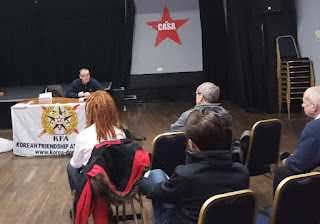
Peter Hendy speaking
by New Worker correspondent


Korean solidarity campaigners held their first public meeting in Liverpool for nearly five years when they returned to the Casa Bar to hear Dermot Hudson and Peter Hendy talk about the developments on the Korean peninsula last month. Despite the cold and windy weather and attention being focussed on the Ukraine crisis people still came to the meeting called by the Korean Friendship Association on 24th February.
    Peter opened the meeting by reminding people of the intense hostility by the US towards the Democratic People's Republic of Korea (DPRK ) which included wqr and sanctions while Dermot talked about the work of the KFA in building solidarity with Democratic Korea at home and abroad.
    The bar is run by the Community Advice Service Association (CASA) – a membership based organisation set-up by the former Liverpool dockers following their epic 28 month long struggle of the Liverpool dockers who were sacked when they refused to cross a picket line in 1995.

Thursday, 20 February 2020

Day of the Shining Star in London

Michael Chant speaking
by New Worker correspondent
People battled their way through Storm Dennis to celebrate the Day of the Shining Star at a meeting in central London last weekend, organised by Korean Friendship Association (KFA) and the Friends of Korea (FoK) committee.
KFA Chair Dermot Hudson introduced the meeting, stressing the importance of the Day of the Shining Star and increasing solidarity with People's Korea. FoK Secretary Michael Chant, General Secretary of the RCPB-ML, spoke about the injustice of the sanctions against the Democratic People’s Republic of Korea (DPRK), stressing the fact the UK is still maintaining the European Union (EU) sanctions against the DPRK despite leaving the EU!
A contribution from the DPRK’s London Embassy was read out. Part of it read: “February 16 is the birthday of Kim Jong Il, eternal Chairman of the National Defence Commission of the Democratic People’s Republic of Korea. When the day comes round every year, many people of the world recall him with deep emotion.
“Kim Jong Il devoted his whole life for the cause of global peace. He led the struggle to build a new world free from aggression and war upholding the banner of anti-imperialist independence.”

Saturday, 14 December 2019

For peace in Korea!

Michael Chant speaking
By New Worker correspondent

Korean solidarity activists returned to the Marchmont Centre in central London last weekend to hear a Democratic Korean diplomat talk about the current situation on the Korean peninsula, at a joint meeting organised by the Korean Friendship Association (KFA) and the Friends of Korea committee.
     Chaired by NCP leader Andy Brooks, a panel of speakers including Michael Chant of the RCPB (ML), Dermot Hudson from the KFA and Kim Song Gi from the London embassy of the Democratic People’s Republic of Korea  (DPRK) spoke about a renewed Korean crisis following the failure of US imperialism to follow up commitments made at the 2018 summit between the US and DPRK leaders in Singapore and the follow-up summit in Vietnam earlier in the year.
Following the historic developments for peace and reunification on the Korean peninsula that took place in 2018, which showed the genuine desire of the DPRK and the Korean people to consign the hostility of the USA and the DPRK to history, the USA is still refusing to fulfil its commitments following the principle of action for action. The promise of the summits between President Trump and Democratic Korean leader Kim Jong Un is therefore not being fulfilled.
At a time when the 29 NATO partners are meeting in London to attempt to revitalise this aggressive alliance, and President Trump himself will be in Britain facing the opposition of the British people, it is vitally important to support the right of the Korean people to self-determination, independence and peace. The meeting called on all Korean solidarity campaigners to strengthen the solidarity of the people’s movements in Britain with the DPRK.

Friday, 8 November 2019

Return from the land of Juche


By New Worker correspondent
Comrades and friends heard Korean solidarity activists talk about their recent delegation to Democratic Korea at the Lucas Arms in central London last weekend. Dermot Hudson and James Taylor were part of a three-strong Korean Friendship Association (KFA) delegation that went to the Democratic People’s Republic of Korea (DPRK) to take part in solidarity meetings last month.
 Both men spoke highly about what they saw in Democratic Korea – the immense progress that could only have been achieved through socialism and the determination of the masses who have closed ranks behind the Workers’ Party of Korea to defend the DPRK’s independence and Korean-style socialism against the threats of US imperialism and its lackeys.
A lively question and answer session was followed by a general discussion on life in the DPRK and the Juche philosophy of great leader Kim Il Sung, who led the Korean people to victory over Japanese colonialism and US imperialism in the 20th century.

Friday, 20 September 2019

Korean solidarity in Bulgaria


By New Worker correspondent


Korean solidarity activists met last weekend to take part in a Juche seminar in the Bulgarian capital of Sofia. Dermot Hudson from the Juché Idea Study Group joined other European delegates for a seminar on the theme of Independence, Sovereignty and International Co-Operation which was supported by the International Institute of the Juché Idea and the Korean Association of Social Scientists.
In the western world Juché is simply described as “self-reliance” but it is much more than that. Juché elevates the philosophical principles of Marxism-Leninism as well as its economic theories and focuses on the development of each individual worker, who can only be truly free as part of the collective will of the masses.
Juché reflects the thinking of Korean communist leader Kim Il Sung, who said that working people could only become genuinely emancipated if they stood on their own two feet. The great Korean leader, who led the Korean people to victory against Japan during the Second World War, developed Korean-style socialism and the Juché idea during his life-time.


Saturday, 3 August 2019

The Korean Victory in 1953

Dermot Hudson and Andy Brooks

By New Worker correspondent

Friends of the Korean people met in central London last weekend to celebrate the defeat of US imperialism in the Korean War that began when the USA and its lackeys attacked north Korea in June 1950. It ended with the USA beaten to a standstill on 27th July 1953. Although the USA signed an Armistice, it still refuses to normalise relations with the people’s government in the north and the Korean peninsula remains divided, with the south still occupied by thousands of US troops.
The meeting, at the King’s Cross Neighbourhood Centre in central London, was called by the Korean Friendship Association (KFA) and opened by KFA Chair Dermot Hudson. He praised the role of great leader Kim Il Sung, who led the Korean people to victory over the US aggressors in the Korean War.
New Communist Party (NCP) leader Andy Brooks pointed out that although Hong Kong had returned to People’s China in 1997 under the formula of ‘one country – two systems’, it was often forgotten that it was Kim Il Sung who first put forward this proposal to end the partition of Korea with the establishment of a ‘Democratic Confederal Republic of Koryo’ in 1980. But the country still remains divided by a monstrous concrete wall built by the south Korean regime in the 1970s and the south remains occupied by US imperialism.
Realistic circles at the helm of the new south Korean government want normalisation and the return of their factories in the ‘special zone’ that was closed in 2016. But that can only happen if the USA recognises the northern government and all the imperialist sanctions are lifted. US President Trump has taken some steps forward in friendly meetings with Democratic People’s Republic of Korea (DPRK) leader Kim Jong Un, but the US leader is still unwilling or unable to deliver the necessary measures needed to end the tension on the Korean peninsula.
A member of the anti-imperialist Italian community in London spoke about the need to support the DPRK against imperialism and the need to build solidarity with Democratic Korea was taken up by many others in the audience. The meeting closed with the showing of a popular DPRK film and much needed refreshments given the very hot weather in the capital over the weekend!

Sunday, 9 June 2019

Korean solidarity in Glasgow


busy at the lit stall at the meeting
By New Worker correspondent

Last Saturday saw the inaugural meeting of the Korea Friendship Association (KFA) Scotland take place in a trendy café in Glasgow’s Merchant City.
The packed and youthful meeting was kicked off by Mitchell Wells, the KFA’s Zone Director for Scotland.
The Chair of the KFA UK, Dermot Hudson, spoke about his recent visits to the Democratic People’s Republic of Korea (DPRK) and about the necessity to counter imperialist propaganda about the DPRK. He noted that many news agencies such as NKNews, which are quoted as objective sources by the BBC, are in fact run by former personnel from the CIA. He also warned about the ‘Liberty in North Korea’ organisation that is active in recruiting on British university campuses. He appealed to members of the audience to visit the DPRK to see the reality for themselves.
Ben Lunn, Secretary of the Communist Party of Britain’s youth wing in Glasgow, outlined the theory and practice of culture in Democratic Korea. He also provided a brief outline of Marxist thinking on the relationship between art and politics, from Plekhanov before the Bolshevik Revolution to Kim Jong Il’s extensive writings on the important role of the cinema in building socialism.
Himself a musician, Lunn paid particular attention to the wide variety of musical life in the DPRK. He was particularly impressed by the ‘youth ensembles’ in the DPRK, which give children excellent chances to participate in music making with instruments especially designed for young hands.
James Taylor then described the work of the Anti-Imperialist National Democratic Front, which operates illegally in opposing reactionaries in the occupied south of Korea.
Mitchell Wells then gave an outline of the concept of the Juche ideology, which he described as a positive development of Marxism-Leninism, and described the present day DPRK as having one class with several strata.
Lively discussion was followed by the election of officers and plans for further meetings and activities, which will include the formation of a Juche Study Group.
The meeting concluded with the election of officers for the new branch and the award of a KFA medal to Mitchell Wells for his long service to the KFA.

Sunday, 21 April 2019

A great Korean revolutionary


Kim Song Gi, Andy Brooks and Michael Chant
By New Worker correspondent

London communists met last week to celebrate the life of Kim Il Sung, who led the mighty movement that freed Korea from Japanese colonialism and established the people’s government in the north that was to become the Democratic People’s Republic of Korea (DPRK). Comrades gathered at the John Buckle Centre in south London for the commemoration called to honour the 107th anniversary of the birthday of President Kim Il Sung, the father of modern Korea, and to hear a report on the current situation by a diplomat from the DPRK embassy in London.
Kim Il Sung not only grasped Marxism-Leninism but he applied it to the concrete conditions of the Korean people. He knew that once the masses realised their own strength they would become unstoppable. He knew that serving the people was the be-all and end-all for Korean communists and for the Workers’ Party of Korea that he launched in 1945. He developed Korean-style socialism and the Juché idea – which elevates the philosophical principles of Marxism-Leninism as well as its economic theories and focuses on the development of each individual worker, who can only be truly free as part of the collective will of the masses.
In the western world Juché is often described as “self-reliance” but it is much more than that. Kim Il Sung said that working people could only become genuinely emancipated if they stood on their own feet – but the Juché idea doesn’t negate proletarian internationalism. The Soviet Union, People’s China and the people’s democracies of eastern Europe all closed ranks behind Democratic Korea during the Korean war.
The Korean people responded with their trade and assistance whenever they could, whilst Korean experts and advisers helped the Vietnamese, the Arabs and the Africans struggling to break the chains of colonialism, and they continue to do so today. And Kim Il Sung’s successors, dear leader Kim Jong Il and leader Kim Jong Un have followed his footsteps to build a modern socialist republic, where every individual worker is master of his or her own life.
New Communist Party leader Andy Brooks opened the formal part of the meeting, which began with a tribute to the life of Kim Il Sung by Michael Chant from the RCPB (ML). That was followed by a talk by Kim Song Gi from the Democratic Korean embassy on Kim Il Sung’s immense contribution to the world communist movement. The Korean comrade also spoke about the current status of negotiations with US imperialism following the collapse of talks between Donald Trump and Korean leader Kim Jong Un in Hanoi in February.
The Q&A session soon led into a lively discussion with the Korean comrade on the efforts of the people’s government to ease tension on the Korean peninsula, and the need to put Korea back on the peace and anti-war movement agenda in Britain and build solidarity with the Korean people on both sides of the divided peninsula.
Finally the comrades sent a solidarity message to Korean leader Kim Jong Un, and called on everyone to support the right of the Korean people to self-determination and independence in the context of taking up the cause of global peace.
The Co-ordinating Committee of the Friends of Korea brings together all the major movements active in Korean friendship and solidarity work in Britain today. It is chaired by Andy Brooks and the secretary is Michael Chant. The committee organises meetings throughout the year, which are publicised by the supporting movements and on the Friends of Korea website.