Sunday, 15 May 2022

Down with the BBC!

 By New Worker correspondent

NCP leader Andy Brooks joined other Korean solidarity campaigners outside BBC headquarters in London last weekend to protest at the ongoing bias of the state-owned broadcaster.
    The protest picket outside Broadcasting House called by the Korean Friendship Association highlighted “the continual ideological attack by the media representatives of world imperialism of which the BBC is part of. This tax-payer funded entity has lied and distorted the truth for decades. It lied about the Iraq war, it lied about imperialism’s attack on Yugoslavia, it lied about Syria’s war against imperialist backed terrorists, it is lying about the situation in Ukraine. They cannot be trusted…simple as that”.
    KFA Chair Dermot Hudson Chairman of KFA said: “The BBC, which is known to progressive people as the British Brainwashing Corporation has consistently lied about the Democratic People’s Republic of Korea (DPRK). Its coverage of the DPRK is one sided and exaggerated to say the least. On several occasions BBC reporters have used tricks and subterfuges to enter the DPRK .
    “The BBC has taken upon itself the role of a shock brigade in the propaganda war against People’s Korea. The BBC is a state broadcaster closely linked to British imperialism and US imperialism... what is disgusting is that not only does the BBC lie about People’s Korea but it expects us to pay for its lies in the form of the BBC licence fee” and concluded “We, the Korean Friendship Association of the UK,believe in defending People’s Korea with no ifs or buts”.

Monday, 18 April 2022

A pillar of the communist movement

by Andy Brooks
Kim Il Sung at a victory rally in October 1945
The New Communist Party joined millions of Koreans and millions more throughout the world communist movement in celebrating the life and times of Kim Il Sung this week. The great leader of the Korean revolution was born on 15th April 1912 and his birthday has long been celebrated as the Day of the Sun in Democratic Korea and by everyone who stands by the DPR Korea .
    Kim Il Sung’s life spanned most of the 20th century. He led the Democratic People’s Republic of Korea for nearly 50 years. He was giant of the international communist movement and an international statesman of great renown. During his life he met Stalin, Mao Zedong, Ché Guevara, Tito, Fidel Castro, Ho Chi Minh, Hafez al Assad and Sukarno and many other Third World leaders as well as western politicians including former US president Jimmy Carter.
    Kim Il Sung dedicated his life to the emancipation of the Korean people, which he did until his last breath in 1994. He was a fighter, a thinker and a leader who developed and advanced Marxist-Leninist theory and led the struggle against Japanese colonialism and US aggression.
    Kim Il Sung was an outstanding communist whose name will forever be remembered as the founder of the modern Korean communist movement that began amongst the patriotic youth of Korea when he was a student in the 1920s.
    Kim Il Sung founded the communist movement that liberated the country from Japanese colonialism, defeated the might of US-led imperialism in the Korean War and led the drive to build the modern, socialist republic that exists today in the north of the divided peninsula.
    Kim Il Sung was a great commander in war and a great leader in peace. He led the people’s government in the north of Korea, so brutally partitioned by imperialism, that led the people in the mass struggle to build a new life after they had won their freedom in 1945.
    The Workers’ Party of Korea, with Kim Il Sung at the helm, led the battle for land reform, education and socialist construction in the 1950s and 60s and then pushed forward on the engineering, technical and scientific fronts to raise living standards and the quality of life for the millions of workers and peasants who had fought for a better tomorrow.
    Kim Il Sung not only grasped Marxism-Leninism but he applied it to the concrete conditions of the Korean people. He knew that once the masses realised their own strength they would become unstoppable. He knew that serving the people was the be-all and end-all for the Korean communists. He developed Korean style socialism and the Juché idea – which elevates the philosophical principles of Marxism-Leninism as well as its economic theories – and focuses on the development of each individual worker, who can only be truly free as part of the collective will of the masses.
    Kim Il Sung sadly passed away in 1994 but his successors are following his footsteps and now with Kim Jong Un at the helm the Korean people are marching into the 21st century to build a modern socialist republic, where every individual worker is master of his or her destiny.


Monday, 11 April 2022

Remembering a great Korean


Andy Brooks speaking
by New Worker correspondent

Friends of Korea gathered last weekend to celebrate the 110th anniversary of the birth of great leader Kim Il Sung, at a meeting at the Chadswell Centre called by the Korean Friendship Association (KFA).
    The meeting began with the Song of General Kim Il Sung and an introduction by Dermot Hudson, the KFA Chair, on the importance of the life of the Korean revolutionary leader who led the guerrilla movement that fought the Japanese imperialism which occupied the Korean peninsula until their defeat in 1945, and later beat back the American horde and their lackeys during the Korean war in the 1950s.
    NCP leader Andy Brooks recalled the time he met Kim Il Sung in 1990 when the New Communist Party established fraternal relations with the Workers Party of Korea (WPK). Keith Bennett, a veteran Korean solidarity campaigner, spoke about Kim Il Sung’s life-long work with national non-aligned countries and the world communist movement.
    Messages were received from the London embassy of the Democratic People’s Republic of Korea and the RCPB (ML), and the meeting ended with the showing of a film about the life of the Korean leader.

Monday, 14 March 2022

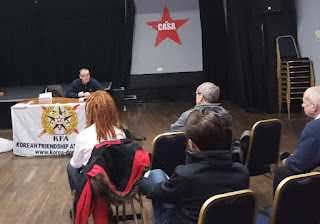
Solidarity at the Casa

Peter Hendy speaking
by New Worker correspondent


Korean solidarity campaigners held their first public meeting in Liverpool for nearly five years when they returned to the Casa Bar to hear Dermot Hudson and Peter Hendy talk about the developments on the Korean peninsula last month. Despite the cold and windy weather and attention being focussed on the Ukraine crisis people still came to the meeting called by the Korean Friendship Association on 24th February.
    Peter opened the meeting by reminding people of the intense hostility by the US towards the Democratic People's Republic of Korea (DPRK ) which included wqr and sanctions while Dermot talked about the work of the KFA in building solidarity with Democratic Korea at home and abroad.
    The bar is run by the Community Advice Service Association (CASA) – a membership based organisation set-up by the former Liverpool dockers following their epic 28 month long struggle of the Liverpool dockers who were sacked when they refused to cross a picket line in 1995.

Saturday, 12 March 2022

The U.S. Should Not Shake International Peace and Stability

 by Ri Ji Song

Researcher, Society for International Politics Study
Democratic People’s Republic of Korea


The greatest danger the world is now faced with is high-handedness and arbitrariness of the United States and its vassal forces that are shaking international peace and stability at the basis.
    The US unilateral and unfair cold war mentality and its bloc-forming external policy make the structure of international relations be transformed into the one of a new cold war, and they strain politico-military situations with each passing day and continue to spawn new knotty problems in different parts of the world.
    In retrospect, the outbreak of the two rounds of the World Wars which brought horrendous calamities and pains of loss originates from the greed of imperialism, and the wars, big and small, on earth in the last century are related, without exception, to the moves of the imperialists to interfere in the internal affairs of others.
    In particular, the air raid conducted by NATO against Yugoslavia at the end of last century served as an occasion of bringing to light the extent of the U.S. and Western hypocrisy in their much-touted global peace and stability, territorial integrity and safeguarding of sovereignty as well as of exposing in all its nakedness who is the real destroyer of international peace and stability.
    The Iraqi war, the Afghan War and other “colour revolutions” which brought the tragedy of 21th century clearly substantiate the fact that the U.S. and the West would seek their policies of hegemony by fair means or foul.
    The present international order is that it has become an immutable law that seeds of discord are sown in every region and country where the U.S. intervenes, and that the relations between the states deteriorate.
    The root cause of the Ukrainian crisis also lies in the high-handedness and arbitrariness of the U.S. which has held on solely to the unilateral sanction and pressure while pursuing only global hegemony and military supremacy in disregard of the legitimate demand of Russia for its security.
    It is not without reason that the international media and experts comment that the contributing factor to the Ukrainian crisis is the imbalance of power in Europe due to the unilateral expansion of NATO and its threat as well as the grave threat to the national security of Russia.
    The U.S embellishes its own interference in internal affairs of others as “righteous” for peace and stability of the world, but it denounces for no good reason self-defensive measures taken by other countries to ensure their own national security as “injustice” and “provocation” - this is just the arrogance of the U.S. style and its double standard.
    Gone are the days when the U.S. used to reign supreme. The U.S., seeing through the trend of the present times, should no longer resort to high-handedness and arbitrariness that disturb international peace and stability.

26th February 2022

Friday, 11 March 2022

DPRK Ministry of Foreign Affairs on Ukraine


28th February 2022

The spokesperson for the Ministry of Foreign Affairs of the Democratic People's Republic of Korea (DPRK) gave the following answer to the question put by KCNA on February 28, as the U.S. piles up sanctions and pressure against Russia with the Ukrainian crisis as a momentum.
    As it became known, the situation of Ukraine is now drawing the attention of the international society.
The root cause of the Ukraine crisis totally lies in the hegemonic policy of the U.S. and the West which indulge themselves in high-handedness and arbitrariness towards other countries.
    The U.S. and the West, in defiance of Russia's reasonable and just demand to provide it with legal guarantee for security, have systematically undermined the security environment of Europe by becoming more blatant in their attempts to deploy attack weapon system while defiantly pursuing NATO's eastward expansion.
    The U.S and the West, having devastated Iraq, Afghanistan and Libya, are mouthing phrases about "respect for sovereignty" and "territorial integrity" over the Ukrainian situation which was detonated by themselves. That does not stand to reason at all.
    The greatest danger the world faces now is high-handedness and arbitrariness by the U.S. and its followers that are shaking international peace and stability at the basis.
       The reality proves positive once again that peace would never settle on the world at any time as long as there remains the unilateral and double-dealing policy of the U.S. which threatens peace and security of the sovereign state.

Thursday, 13 January 2022

Heroes of the Korean War!

by Keith Bennett


The Battle at Lake Changjin, directed by Chen Kaige, Tsui Hark and Dante Lam, premiered at the Beijing International Film Festival on 21st September 2021 and was released in China on 30th September. As part of its international distribution it has been showing at selected cinemas all over the world. With a budget of some $200 million it is the most expensive Chinese film ever made. The acclaim with which it has been received however, has also made it the highest grossing film of 2021, the highest grossing film in Chinese history and the highest grossing non-English language film.
    At just two minutes under three hours in length, the film is a revolutionary epic, with the main action centred around the Changjin Lake area of the Democratic People’s Republic of Korea (DPRK) in the bitterly cold winter of 1950, shortly after the Chinese People’s Volunteer Army (CPVA) intervened to help the Korean people during the conflict the Chinese call the War to Resist US Aggression and Aid Korea.
    Confronted with the harshest natural and climatic conditions, forced to survive on starvation rations and faced with an enemy that was better trained, better equipped, better fed, better armed and with complete mastery of the skies, the Chinese troops “fearing neither hardship nor death”, to use the well-known Chinese expression, continued to forge ahead in the most courageous and ingenious of ways. Armed with the element of surprise, and although making the ultimate sacrifice, by successfully blowing up the Shuimen Bridge they scored the most decisive victory, ultimately ensuring the achievement of China’s objectives in the war.
    A great strength of the film is how it weaves into a seamless whole the grand politics of national leadership and vital decisions of war and peace with the lives, sentiments and aspirations of the masses of poor and working people, those whom Chairman Mao always insisted were the real heroes. We see Mao addressing his comrades and arguing his case. We see him absorbed in contemplation. We see his close comradely relations with the CPVA commander Peng Dehuai (something that tragically was not to survive the later twists and turns of the revolution), and we see the interplay between Mao Zedong, his son Mao Anying and Peng.
    Already a seasoned revolutionary in his own right, Anying is determined to be amongst the first to volunteer for the Korean front. Peng tries his best to dissuade him. He doesn’t want the Chairman to be left without his son. But Anying cannot accept that his family should not make the same sacrifices that countless other families throughout China would make. It is Mao Zedong who tells Peng to “let him go”, not because he doesn’t love his son, but because he loves all the sons and daughters of the Chinese working people – something that recalls Stalin’s attitude when his son was held a prisoner of war by the Nazis and which reputedly originally inspired the title of Arthur Miller’s 1946 play All my Sons.
    This interplay may be said to constitute a bridge to the depiction of the mass of Chinese people in war and revolution. The film begins with People’s Liberation Army soldier Wu Qianli returning to join his illiterate parents and younger brother in their home village in Zhejiang province and carrying an urn containing the ashes of his other brother Wu Baili, who has fallen as a revolutionary martyr. Although Qianli will return to the army, he assures his worried mother, who has already lost one son, that the war is over and there are no more battles to be fought. As a result of land reform, the family have been given a modest amount of land as their own and Qianli’s great dream and plan is to build there a home fit for his parents to live in.
    He has scarcely reached home however, before he is called to leave at once for Korea. Again relating the vital questions of international politics to the daily concerns and needs of the people, the point is made that those who have at last gained their own home and land must now fight to repel those who would come and take it away. In a separate scene, Mao opines that the country has only just been liberated. There is so much to do to build a new China. He doesn’t want to fight another war at this time. But if, he presciently observes, this war brings China decades or even a century of peace, then it will be worth it. Moreover, Mao observes, by sending its military forces to Taiwan, the USA has already committed aggression against China.
    Later, in the terrible conditions of battle, the soldiers console themselves with the thought that their sacrifice will mean that their children will not need to endure the horrors of conflict. They will enjoy a better life in peace. For this reviewer, it was a touching vindication of that to be able watch the film in a cinema in London’s West End, with an audience otherwise made up of young students from China.
    Much of the film’s human story is centred on the relationship between Wu Qianli and his younger brother Wu Wanli. Wanli’s brother is a people’s army soldier and a revolutionary martyr, whilst, at least initially, he is a mischievous, somewhat ill-disciplined but in reality quite naïve peasant boy, who starts out by thinking that war is some kind of adventure or game.
    Qianli is horrified that Wanli has sneaked away to enlist together with him. Wanli’s progression from naïve teenager to heroic soldier and revolutionary, and not just in a military sense, but for example in learning to write a self-criticism, in a sense recalls the evolution of Pavel Korchagin in the classic Soviet novel How the Steel was Tempered. Towards the end, it is noted that the Wan in Wanli means ten thousand, indicating that his example will be followed by countless revolutionary successors.
    The developing relationship between Qianli and some of his closest comrades on the one hand, and Wanli on the other, plays out against the lives and interactions of the company as a whole. The good-natured ribbing conceals but also highlights and nurtures a deep camaraderie characterised by a willingness to sacrifice for others, both for the person next to you and for the wider cause, a profound humanism and a genuine comradely love. The resulting political synthesis of revolutionary heroism and class hatred, of patriotism and proletarian internationalism, becomes the living embodiment of Chairman Mao’s great call to Resist America, Aid Korea, Safeguard the Motherland and Defend our Homes.
    The film provides a vivid, intense and at times harrowing depiction of just what it means to fight with next to nothing against almost insuperable and apparently hopeless odds – in exposed terrain at the mercy of US bombers and in temperatures that often fall to more than minus 40 degrees Celsius, compounded by a lack of food and adequate warm clothing. And to triumph in the face of such adversity. There is a poignant contrast between the lavish Thanksgiving dinner enjoyed by the US troops at their base with the Chinese volunteers attempting to ward off starvation with a handful of small, rotten and undercooked or raw potatoes – sharing with each other what very little they had. But no amount of roast turkey with all the trimmings can obscure the dawning realisation that Douglas MacArthur’s boast, seen towards the start of the film, of victory by Thanksgiving and home by Christmas was not going to materialise.
    `The note of caution raised at the start, that behind Kim Il Sung stood Mao Zedong and Stalin, was arrogantly dismissed with chauvinistic deprecation of peasant fighters. But the history of the 20th Century is in major part a history of Asian peasants fighting and defeating US imperialism and its stooges – in China, Korea, Vietnam, Laos and Cambodia. They were often equipped with the most rudimentary of weapons – but they were also equipped with the most advanced revolutionary science of Marxism-Leninism and the leadership of a communist party. Of course, both the fact that China chose to make this film at this time, and the fact of its phenomenal box office success, is not unrelated to the New Cold War unleashed by imperialism against China and other socialist and anti-imperialist countries – a cold war that, just as it did in Korea in 1950, can all too easily become an outright military conflict. For Asian workers and peasants in power, however, the days of fighting with rudimentary weapons are over. People’s China and Democratic Korea are both proud nuclear powers, ready and able to defend their independence, sovereignty and socialist gains, as Malcolm X memorably put it, “by any means necessary”.
    It should not be the job of a reviewer to say too much about a film’s ending but suffice to mention that even a US commander is finally moved to salute the courage of the CPVA troops and to opine that it is impossible to prevail against men with such a degree of motivation. This symbolism brought to mind the words of Comrade Fidel Castro, speaking about Bobby Sands and his fellow hunger strikers in the north of Ireland: “Let tyrants tremble before men who are prepared to face death after more than 60 days without food.”

The Battle at Lake Changjin is currently freely available on YouTube and Vimeo.